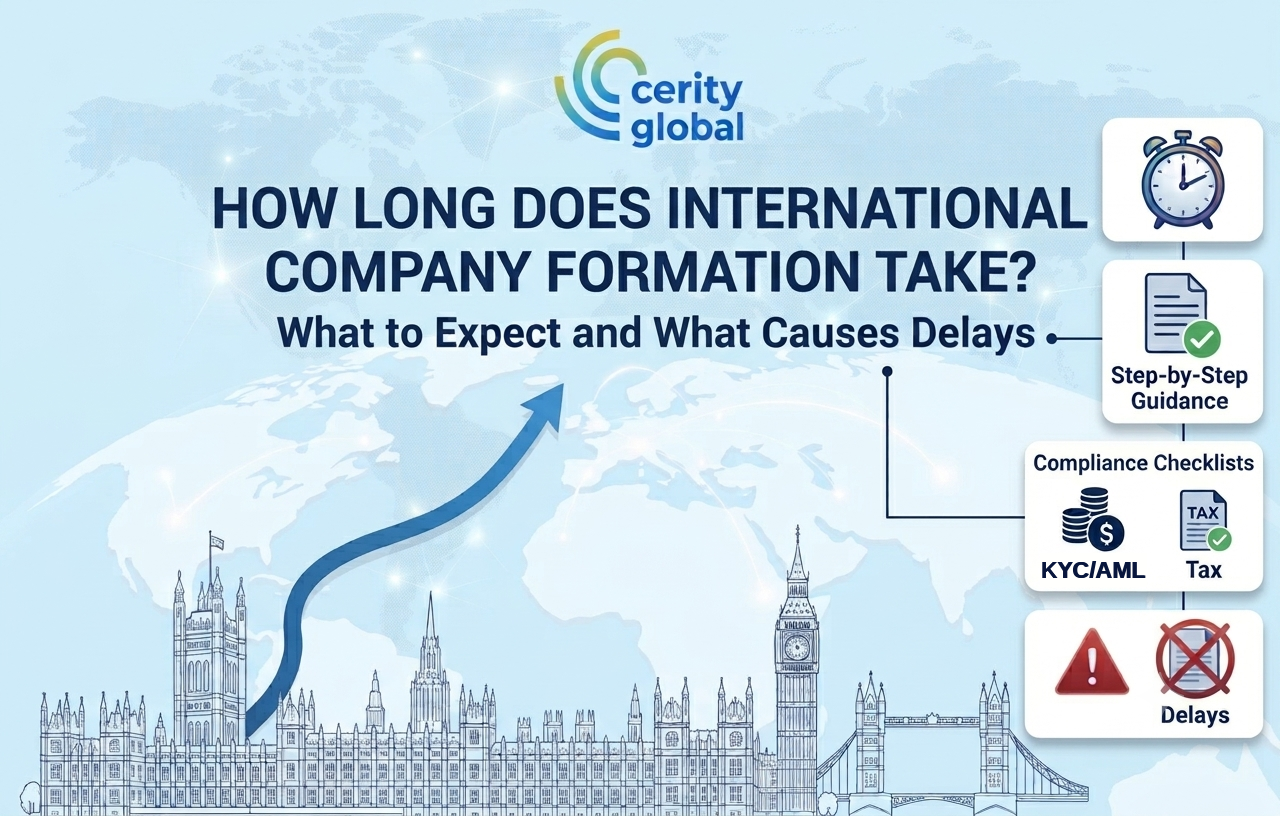
When expanding into an international market, it usually starts with a clear business objective. A company might choose to set up a regional office, recruit local staff, provide in-country support, or have a permanent presence in a foreign country. But before one starts to proceed, it is important to ask one question: How long does it take to be a legal entity in the market?
This is subject to several variables such as country, business structure, ownership specifications, documentation, and regulatory approvals. In certain jurisdictions, a company may be given its incorporation certificate within a few days. In others, it may take months to set up a foreign company and complete the registrations.
Incorporation is just one aspect of the matter for international enterprises. Opening a corporate bank account, completing tax registrations, meeting employer requirements, and obtaining industry-specific licenses can add further time.
This blog covers the time it takes to set up a company internationally, the requirements for companies to be registered in other countries, the costs involved, and some of the preparation that must take place before businesses enter a new market.
How Long Does It Take to Establish a Legal Entity in the Market?
The typical time needed to form an international company is usually one to two weeks. International company formation has no general timeframe. The incorporation process in jurisdictions with a digital registration system can take a few days, and the process of creating a foreign-owned secondary can take weeks or months, depending on the jurisdiction.
The Business Ready (B-READY) 2024 report by the World Bank rated the business environment in 50 economies. Its results revealed that it takes up to 106 days to register a foreign company, and up to 80 days to register a domestic company.
Foreign companies may also be subject to extra requirements such as notarization, a local representative, identity verification, local regulatory approvals, and shareholder documentation, among others.
The following are only estimates and not guaranteed government processing times for planning purposes:
| Company formation stage | Indicative timeline |
|---|---|
| Straightforward digital incorporation | 1–10 business days |
| Standard foreign-owned incorporation | 2–6 weeks |
| Incorporation involving additional approvals | 1–3 months |
| Complete operational setup | 1–4 months or longer |
Businesses should distinguish between legal incorporation and operational readiness. Receiving a certificate of incorporation does not necessarily mean the company can immediately hire employees, process payroll, obtain licenses, or begin regulated activities.
How Long Does Company Registration Take in Different Countries?
The company's incorporation timeline varies across markets. The following examples illustrate how registration requirements can affect international business setups.
1. United Kingdom
Standard digital incorporation: Usually within 24 hours
The United Kingdom offers a relatively straightforward digital company registration process. Companies House allows businesses to register a limited company online or through approved software.
Standard eligible applications are normally processed within 24 hours. Foreign businesses must also consider director appointments, registered office requirements, ownership verification, and supporting documentation.
Source - GOV.UK – Register Your Company
Following incorporation, companies may need to arrange Corporation Tax, PAYE registration where applicable, corporate banking, and employment-related registrations.
Business consideration: The UK offers a relatively quick incorporation process, but businesses planning to hire employees or establish operational facilities should account for additional requirements.
2. Singapore
Timeline: Depends on structure and registration requirements
Singapore offers several options for foreign businesses, including establishing a secondary, registering a branch office, or setting up a representative office.
The Accounting and Corporate Regulatory Authority (ACRA) requires foreign businesses to engage a registered corporate service provider for registration.
A secondary is a separate Singaporean legal entity, whereas a branch remains an extension of the foreign parent company. A representative office is generally intended for market research and cannot earn income.
After registration, businesses may need to open a corporate bank account, maintain statutory records, appoint required officers, and obtain relevant business licenses. Employers must also consider CPF and local employment obligations.
Business consideration:Singapore offers structured options for foreign businesses, but incorporation and operational readiness should be planned as separate milestones.
Source - ACRA – Ways to Set Up Foreign Businesses
3. India
Timeline: Several weeks for many foreign-owned setups
Foreign companies entering India commonly consider establishing a wholly owned secondary or another permitted business structure, depending on sector-specific investment regulations.
The process can involve obtaining digital signatures, preparing parent-company documents, completing director and shareholder verification, and filing incorporation applications with the Ministry of Corporate Affairs (MCA).
Source - Ministry of Corporate Affairs(MCA)
Foreign parent documents may require notarization, apostille, or consular authentication, depending on their country of origin.
Companies may also need to arrange corporate banking, complete applicable Reserve Bank of India reporting, and obtain tax and employer registrations.
Professional service providers estimate that foreign-parent secondary incorporation can take approximately 15 to 20 business days after the required documents are ready. Banking and other formalities may extend the overall process.
Business consideration: Companies entering India should plan for document authentication and banking requirements early, as these can affect the launch schedule.
What Do These Country Examples Tell Businesses?
The examples demonstrate that incorporation speed should not be the only factor in selecting a market-entry destination. A company may complete its legal registration quickly but still needs additional time to open a bank account, obtain operational approvals, register for payroll, and establish local compliance processes. For international businesses, the more useful question is how long it will take to become ready for commercial operations.
Understand your target country's incorporation requirements and timelines before you expand.
Planning to Set Up Your Business Abroad?
Talk to a Global Expansion Expert →What Are the Main Stages of International Company Formation?
Although the exact procedure varies by jurisdiction, international company formation generally involves the following stages.
1. Selecting the Country and Legal Structure
The first step is determining where the company should establish its legal presence, and which structure supports its business objectives.
Companies should evaluate target customer markets, foreign ownership restrictions, corporate tax requirements, local hiring regulations, banking requirements, and ongoing compliance obligations.
A secondary may be suitable for a business planning long-term operations, while a branch may work for a company extending its existing business into another market.
2. Preparing and Verifying Documents
The company must prepare the required incorporation documents, including parent-company records, shareholder information, director identification, and board approvals.
Businesses should confirm documentation requirements before initiating registration. Missing shareholder details, incorrect company records, or incomplete identification documents can result in additional filing time.
3. Company Name Approval and Incorporation Filing
The next step generally involves checking name availability and submitting the incorporation application to the relevant government authority.
The application may include details of shareholders, directors, registered office, business activities, and ownership structure. The authority reviews the application and may request corrections before approving registration.
4. Receiving the Certificate of Incorporation
Once the application is approved, the relevant authority issues the certificate of incorporation or equivalent registration document. This confirms the company's legal existence under the applicable corporate framework.
However, certain sectors and business activities may require separate licenses or approvals.
5. Completing Tax and Employer Registrations
Following incorporation, companies may need to register for corporate income tax, VAT or GST, payroll withholding, social security, and other applicable obligations.
Businesses planning to hire employees should also prepare local employment agreements, payroll processes, and statutory benefit arrangements.
6. Banking and Ongoing Compliance
The company may need to submit incorporation documents, ownership details, board resolutions, and identification records to open a corporate bank account. Before beginning regular operations, businesses should also establish accounting, bookkeeping, tax filing, annual reporting, and payroll processes.
Why Can International Company Formation Take Longer Than Expected?
Even when a country has an efficient incorporation system, practical issues can extend the overall timeline.
- Incomplete documentation:Missing or inconsistent documents can lead to application rejection, clarification requests, and repeated submissions.
- Foreign document authentication:Parent-company records and shareholder documents may require notarization, apostille, or consular legalization.
- Regulatory approvals: Certain industries require additional government approval involving separate assessments and supporting documents.
- Banking and KYC procedures:Financial institutions conduct independent ownership and identity checks. Their approval timelines are separate from incorporation processing.
- Local representative arrangements: Finding an eligible resident director, registered agent, or authorized representative may require additional preparation.
- Complex ownership structures:Multiple corporate shareholders and beneficial ownership verification can increase the time required to complete registration.
These delays do not necessarily occur during incorporation itself. Some arise before filing, while others appear after the company has already been registered.
How Much Does International Company Formation Cost?
The cost of setting up a company abroad depends on the jurisdiction, entity type, ownership structure, and operational support required.
Government incorporation fees are only one component of the total investment. Businesses should consider both initial setup expenses and recurring administrative costs.
Initial Company Formation Costs
Initial expenses may include:
- Government registration and filing fees.
- Company name reservation.
- Notarization, apostille, and document certification.
- Registered office and local representative services.
- Director or shareholder verification.
- Professional incorporation fees.
- Industry-specific licenses and approvals.
- Initial banking and capital requirements, where applicable.
Ongoing Company Maintenance Costs
After incorporation, businesses should also budget for:
- Accounting and bookkeeping.
- Corporate tax preparation and filing.
- Annual returns and statutory reporting.
- Payroll administration and employer contributions.
- Company secretary or registered agent services.
- Registered office expenses.
- Audit and financial reporting were required.
- Local HR and compliance support.
For companies planning to maintain a foreign secondary over several years, recurring expenses can significantly affect the total cost of international expansion. A lower incorporation fee does not necessarily mean a lower overall cost of doing business.
How Can Businesses Reduce International Company Formation Delays?
Companies cannot control every government or banking process, but they can reduce avoidable delays through proper preparation.
- Confirm the legal structure before registration:Review whether a secondary, branch, or representative office supports the intended business activities.
- Prepare foreign shareholder documents in advance: Collect parent-company records, director identification, ownership information, and board approvals before filing.
- Check out local director’s requirements:Confirm whether the country requires resident directors, local representatives, or specific shareholder arrangements.
- Start banking preparation early: Understand KYC requirements, beneficial ownership checks, and document expectations.
- Identify tax and employment registrations: Prepare for payroll, social security, statutory benefits, and employer registrations if the company intends to hire employees.
- Work with local professionals: Country-specific support can help identify documentation gaps, registration requirements, and post-incorporation responsibilities.
Get support with company registration, documentation, and post-incorporation requirements.
Ready to Establish Your International Business?
Book Your Free Consultation →How Cerity Global Supports International Company Formation?
Establishing a foreign legal entity involves more than submitting incorporation of documents. Businesses also need to understand local registration requirements, prepare supporting documentation, and establish the processes required to operate after registration.
Cerity Global supports international companies with business setup and global expansion requirements across more than 170 countries.
Its support can include:
- Legal Entity Setup: Assistance with company incorporation, documentation, local registrations, and corporate bank account setup.
- Country-Specific Business Support:Guidance on local requirements, ownership structures, registered office arrangements, and operational considerations.
- HR and Payroll Support: Assistance with local employment agreements, payroll administration, statutory benefits, and employer-related requirements.
- Accounting, Tax, and Compliance: Support with ongoing financial reporting, accounting, tax-related requirements, and corporate compliance.
- Transition to Direct Employment: Planning support for companies moving from an Employer of Record (EOR) arrangement to their own legal entity while maintaining employment and payroll continuity.
Final Thoughts
International company formation can take anywhere from a few days to several months, depending on the country, legal structure, ownership requirements, and regulatory procedures.
While some jurisdictions offer quick digital incorporation, foreign-owned businesses may need additional time for document authentication, banking, tax registrations, and operational approvals.
For decision makers, the priority should be to establish a realistic timeline that covers the entire setup process, not just the date of incorporation. This helps businesses coordinate investment, recruitment, market entry, and operational planning more effectively.
A well-planned company formation process can provide the legal and operational foundation needed for sustainable international growth.
Planning to Establish Your Business in a New Country?
Every market has different incorporation requirements, documentation procedures, and operational timelines. Understanding these requirements before starting can help your company plan its international expansion with greater clarity.
Share your target country, proposed business structure, and expansion objectives with Cerity Global to understand the registration process and the support required to establish your foreign entity.
Frequently Asked Questions (FAQs)
It can take anywhere from a few days to several months. The timeline depends on the country's registration system, entity type, foreign ownership requirements, document verification, and regulatory approvals.