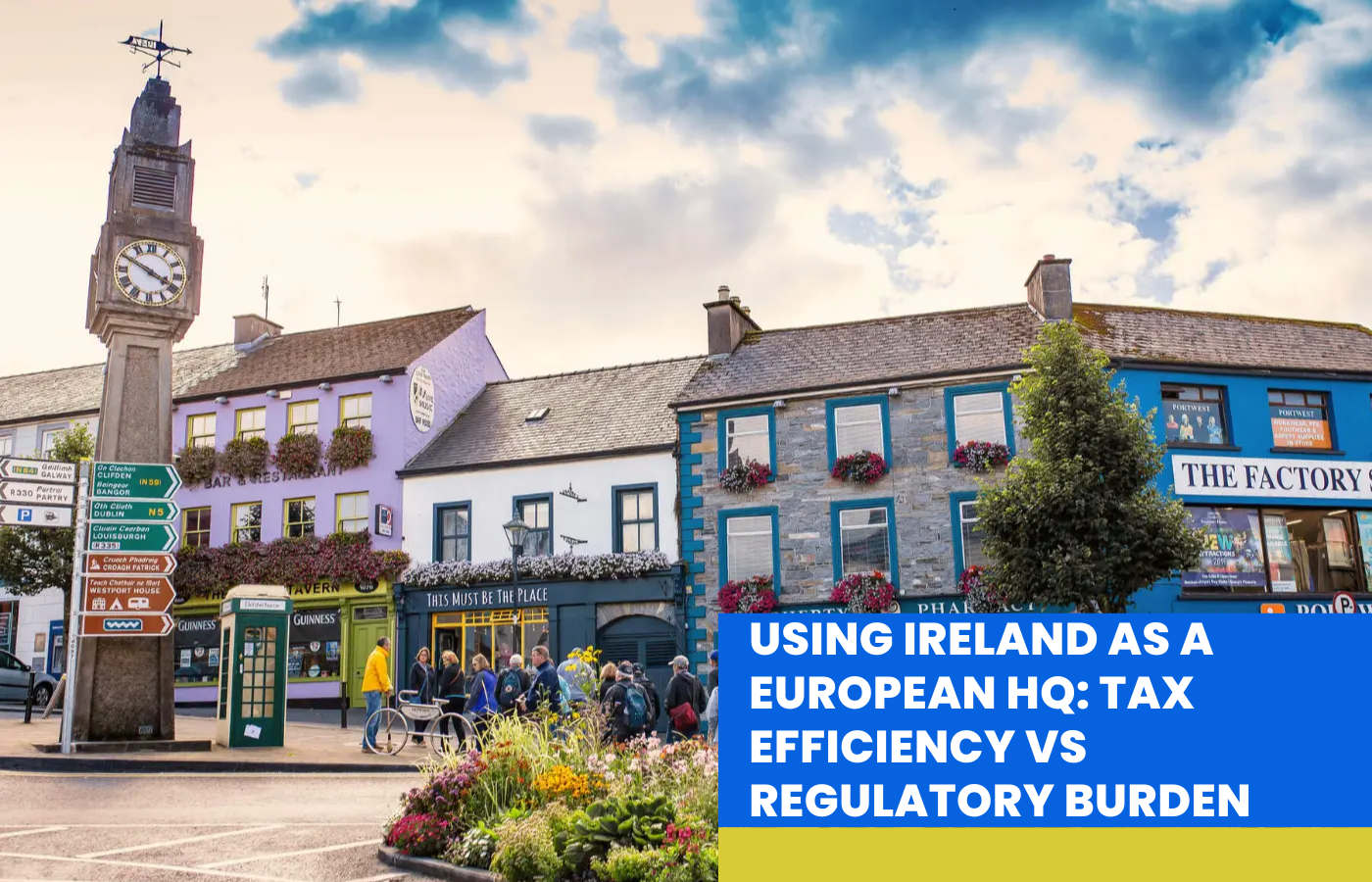
Ireland is the home of over 1,800 multi-national firms operating in Europe. Despite the rising regulatory pressure and evolving international tax regulations, global brands in a range of industries, including technology, pharmaceuticals, financial, and software, are still pouring money into the nation.
It is an important question for those planning to expand to Europe; is it still worth Irish HQ in Europe in 2026?
This time it is not so simple as it was 10 years ago. While Ireland remains one of the most desirable corporate tax rates in Europe, tax hasn't become the sole determinant of location. The global minimum tax rules, economic substance requirements, compliance requirements, and rising operational costs have transformed the discussion.
The real challenge for US and international businesses considering establishing a presence in Ireland is knowing both the pros and cons. The companies that are doing best are not just seeking to cut taxes. They're searching for a place where they can sustain growth, access talent, be operationally scalable, and comply in the long term.
So, in this guide, we will explore whether it remains strategic for businesses to operate in Ireland as a European HQ in 2026 and what businesses should be mindful of when establishing a legal entity in Ireland
Why Do So Many Global Companies Choose Ireland for Their European Headquarters?
Ireland has spent decades positioning itself as one of Europe's most attractive destinations for international investment.
According to IDA Ireland, the country's investment promotion agency, foreign direct investment-supported companies employ more than 300,000 people directly, while thousands of additional jobs are supported indirectly through the broader economy.
Several factors continue to drive demand for company registration in Ireland.
Access to the European Union Market
A legal entity in Ireland will have access to the EU Single Market, meaning that a company can cater to customers in different member states from its one strategic location.
When businesses in the United States wish to venture into Europe, Ireland frequently serves as a gateway to the Nordic region, Italy, Spain, France, and Germany.
English as the Primary Business Language
Many businesses overlook the benefit of language. Communicating contract negotiations with regulatory bodies, in employment documentation, and with customers can all be done in English, minimizing hassles for international teams.
Ireland's Role as Europe's Localization and Internationalization Hub
Ireland's appeal to multinational companies extends beyond tax efficiency and access to the European market. During the 1980s and 1990s, many US companies selected Ireland as their European base because they needed a central location from which to distribute products and services across multiple European countries.
As businesses expanded across Europe, they faced a significant challenge: adapting products, software, documentation, customer support materials, and marketing content into numerous local languages. Serving customers in Germany, France, Spain, Italy, the Nordic countries, and other European markets required high-quality translations and localized user experiences.
This demand helped establish Ireland as one of Europe's leading translation, localization, and internationalization hubs. Over time, the country attracted multilingual professionals, translators, software engineers, and localization specialists from across Europe who supported the adaptation of products and services for diverse European markets.
The development of this ecosystem created long-term advantages for multinational companies. Businesses could centralize localization, customer support, software adaptation, and international product management functions within a single European headquarters while efficiently serving customers across multiple countries.
Today, Ireland continues to benefit from this legacy, particularly for technology, SaaS, software, life sciences, and digital services companies that require multilingual operations and localized customer experiences throughout Europe.
Strong Talent Availability
The global high-tech industry, including technology, software development, finance, biotechnology, cybersecurity, and the pharmaceutical industry, continues to attract highly qualified professionals from around Europe and the world.
In addition to technical talent, Ireland has developed a strong pool of multilingual professionals with expertise in translation, localization, international customer support, and global product management, reflecting its long-standing role as a gateway for companies serving multiple European markets.
A Proven Multinational Ecosystem
Ireland is NOT an emerging market experiment. It is a well-established multi-national centre.
This existing professional services infrastructure, coupled with legal expertise, accountants, recruitment agencies, and compliance experts, all contribute to the ease with which a company can enter the market.
Is Ireland Still Tax-Efficient for International Companies in 2026?
Tax remains one of the primary reasons businesses explore company formation in Ireland
However, the tax discussion has become more complex than simply referencing Ireland's corporate tax rate.
Understanding Ireland's Corporate Tax Rate
Ireland's 12.5% corporate tax rate on trading income remains one of the lowest rates among developed economies.
For businesses generating operational revenue, this continues to provide a competitive advantage compared with jurisdictions where effective tax rates can exceed 25%.
How has OECD Pillar Two affected International Tax Planning?
A major false myth among executives is that the tax advantage for Ireland is now gone due to the international tax minimum taxes.
The truth is that OECD Pillar Two mainly affects the largest multinational companies with revenues of more than €750 million annually.
Ireland has a traditional corporate tax regime that helps smaller and medium-sized businesses to continue to thrive.
There is a tendency for businesses to rule Ireland out too early, due to the perception that all tax benefits have been removed from the market. Often, that's not the case.
Tax Efficiency is Not the Only Decision Factor
Ten years ago, tax optimization was frequently in the driver's seat when deciding where to locate.
In the modern era, regulators are looking for business activity, both tangible and real, and for the ability to make decisions locally.
Therefore, businesses should look at Ireland's ability to meet their compliance requirements, their ability to attract talent, their scalability, and their long term business goals.
What Regulatory Requirements Should Foreign Companies Expect in Ireland?
Tax efficiency receives significant attention, but regulatory obligations frequently determine whether an expansion strategy succeeds.
Corporate Governance Requirements
Foreign-owned entities operating in Ireland must comply with various governance obligations.
These include:
- Annual filings
- Financial reporting
- Corporate record maintenance
- Director responsibilities
- Shareholder documentation
Failure to maintain proper governance standards can result in penalties and operational complications.
Beneficial Ownership Reporting
Transparency requirements have increased significantly.
Businesses must disclose ultimate beneficial ownership information and maintain accurate records.
This has become a standard expectation across many jurisdictions and reflects broader international compliance trends.
Transfer Pricing Compliance
Cross-border transactions between related entities are subject to transfer pricing rules.
Companies expanding into Europe frequently underestimate the documentation and reporting requirements associated with intercompany arrangements.
Data Privacy and GDPR Compliance
For organizations handling customer data within Europe, GDPR compliance remains a major consideration.
Many executives focus on entity formation while underestimating the operational investments required to support privacy compliance.
Economic Substance Rules: Why Many Foreign Companies Get This Wrong
In this section, we will discuss why the Economic Substance Rules are so often misunderstood by foreign companies.
A key aspect of international tax planning is economic substance.
What is meant by the term ‘economic substance'?
The concept of economic substance is related to the need for businesses to have “economic activity” in the jurisdiction in which they seek tax benefits.
These include:
- Local employees
- Office facilities
- Strategic decision-making
- Commercial activities
- Management presence
Common Mistakes That We See
One common error is to see Ireland as nothing more than a tax system.
There are a number of organisations that set up a legal company in Ireland but do all of their work in another country.
Arrangements are becoming the subject of more questions from regulators when there is little meaningful local activity.
What We See in Practice
Some of the most successful expansions consider Ireland as a real operational headquarters.
These companies develop local teams, introduce management capabilities, and create distinct business substance, which enables them to sustain their plans.
As a consequence, not only compliance but also enhanced operational performance.
How Much Does it Cost to Form a Company in Ireland?
Operation costs tend to be overlooked, whereas tax savings are given a great deal more attention.
This sets up false expectations.
Company Registration Costs
The registration of a company in Ireland does not cost a great deal.
However, registration fees are just a small part of the cost of expansion.
The cost of talent and payroll
The high demand for skilled workers has grown due to Ireland's vital economy. However, the talent pools of technology, financial, and pharmaceutical companies are often similar.
Also, the Wages are still on the rise, notably in Dublin.
Cost of compliance and administration
It is important to plan for the following when investing in a website:
- Accounting services
- Tax filings
- Corporate secretarial support
- Payroll administration
- Legal advisory services
Failure to attend to these continuous requirements may result in budgeting surprises after incorporation.
Office and Infrastructure Expenses
The price of commercial real estate continues to be one of Europe's highest. Some of the strain has been abated with hybrid working, but there are still office costs to consider.
Moreover, to know more about setting up a legal entity in Ireland, know more details about Ireland.
Ireland vs Netherlands vs Germany: Which European HQ Location Is Best?
There are a number of companies that benchmark Ireland's country strengths against the leading countries in Europe for expansion.
Ireland vs Netherlands
The Netherlands has a highly developed logistics sector and is well-connected internationally.
Ireland can offer benefits in terms of:
- Corporate tax rates
- English-language operations
- Technology sector concentration
Ireland vs Germany
Germany offers direct access to Europe's biggest economy.
But companies do tend to face:
- Higher employment costs
- Greater administrative complexity
- Stricter regulation, which is more comprehensive
Ireland vs Luxembourg
Luxembourg continues to be an investment structure and a financial services location.
Overall, Ireland offers a wider range of options for businesses interested in active commercial operations throughout Europe.
Ultimately, it depends on the needs of the business, not just on the taxes.
What Challenges Do Foreign Companies Face After Company Registration in Ireland?
A lot of expansion plans do emphasize installation and neglect operations.
Hiring and Employment Compliance
The planning of employment regulations is crucial.
Common mistakes include:
- Incorrect contract structures
- Payroll compliance errors
- Misclassification issues
By tackling these challenges early, risk is minimised.
Managing growth across Multiple Countries
Although Ireland can be used for a headquarters address, there are other EU markets to expand into that have other compliance needs.
Establish scalable processes from the start.
Maintaining Compliance Over Time
Creating compliance is not about one-off projects.
Reporting requirements, governance, and regulatory requirements remain in place throughout the life of the business.
How to Set Up a Legal Entity in Ireland Successfully?
Expansions are usually successful in a structured manner.
Step 1: The first step is to establish the Expansion Objective
Explain if Ireland will become:
- A sales hub
- A regional headquarters
- An R&D center
- A service center of a customer support system.
In terms of the answer, this impacts things like entity structure and compliance requirements
Step 2: The second step is to choose the appropriate corporate structure
The focus on the entity should be in line with:
- Tax strategy
- Ownership requirements
- Funding plans
- Future growth objectives
Step 3: Create Substance From Day One
Don't consider substance an afterthought.
Building credibility in operations early on gives fuel for growth.
Step 4: Make plans for future compliance.
Governance, reporting, and administrative needs must be part of the initial budget for the expansion.
Bottom Line: Does Ireland's Tax Efficiency Still Outweigh the Regulatory Burden?
Ireland is still one of the great European locations to set up a European head office in 2026 for many international companies.
It remains tax-efficient, open for EU investment, has access to skilled talent and innovation tax incentives, and the business climate is favorable, continuing to entice multinationals to invest in it.
Together, the expectations of regulators are quite high. Businesses have found themselves in a different position 10 years later, due to the economic substance requirements, obligations to report, governance standards, and compliance obligations.
Those that have the highest success rates are organisations that are thinking of Ireland as more than just a tax haven.
In the case of companies considering their company formation in Ireland, company registration in Ireland, or when establishing a legal entity in Ireland, it is crucial to get the tax planning, compliance preparation, and business objectives right from the outset.
Whether you are looking to incorporate a legal entity in Europe, manage a legal entity's compliance, or develop an expansion strategy for sustainable growth, Cerity Global can assist you.