
Incorporation papers filed, bank account open, and tax registration confirmed.
On paper, the entity exists, yet on payday, employee paychecks are often still routed through the same Employer of Record that has processed them for the past year.
That gap between legal existence and operational readiness is where most EOR-to-entity transitions either run smoothly or quietly go wrong. Payroll doesn't fail because the entity setup was mishandled. It fails because the handoff between the old employer of record and the new one was treated as an afterthought.
For companies already past the "what is an EOR" stage and actively planning a move, the real question isn't whether to transition. It's what actually happens to payroll once the switch is made and how to keep it from becoming the weak link in an otherwise well-executed expansion.
So, let’s get into this blog and learn in detail.
Planning your own EOR-to-entity move?
Talk To Cerity GlobalWhy Do Companies Move from EOR to a Local Entity?
Most organizations start with an EOR because it's the fastest way to get a hire on the ground. The global EOR market is valued at roughly USD 6 billion in 2026, with North America accounting for the largest regional share, reflecting how widely U.S. companies rely on this model for international hiring.
But EORs are built for speed, not scale. Once headcount in a market grows, or a company needs local banking relationships, IP ownership, or government contracting eligibility, direct employment through a legal entity becomes the more sustainable structure. Payroll is the operational core of that switch.
Does Payroll Stop or Continue During an EOR-to-Entity Transition?
Payroll should continue. It should not stop.
How should it work?
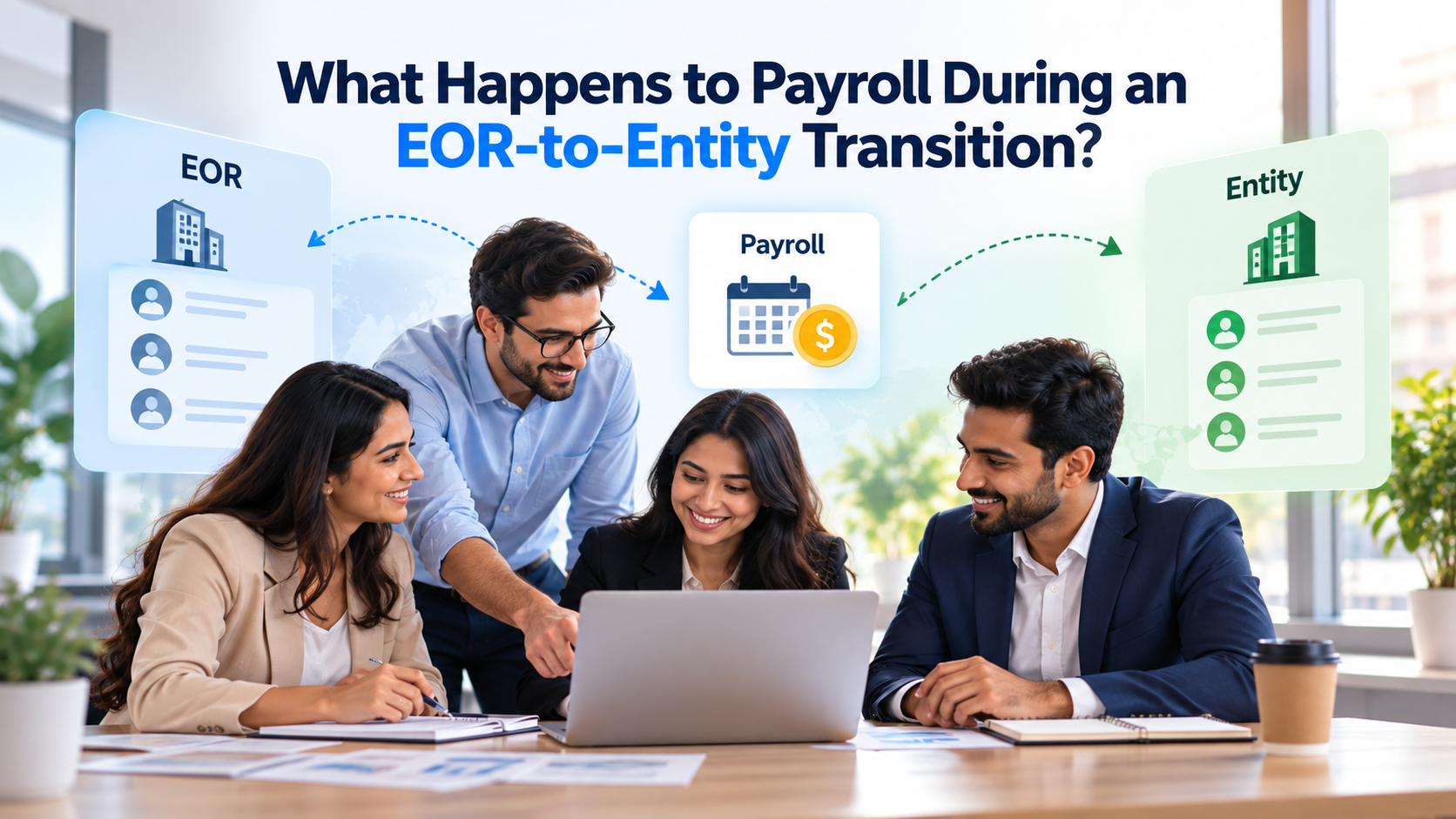
Run the outgoing EOR and the new entity's payroll in parallel. Do this for at least one full pay cycle. Employees keep getting paid on the same schedule.
Why should the paycheck timing not change?
The legal employer changes.The pay date is not.Employees should not notice any gap.
Where can transitions go wrong?
Teams schedule entity registration and payroll are sequenced too tightly, leaving no buffer for a delayed tax ID or bank account approval to disrupt a pay run.
How to avoid this?
- Finish registration and payroll setup well before the cutover date.
- Keep the EOR running payroll until the entity's first pay run is complete.
What Changes in Payroll When You Move Off an EOR?
Several things shift simultaneously, even though the employee's day-to-day role stays the same:
- New employer tax identification and registrations:The entity must be registered with local tax and social security authorities before it can legally run payroll.
- A new payroll system or provider:Payroll moves from the EOR's infrastructure to either an in-house system or a locally compliant payroll processor tied to the new entity.
- Re-signing employment contracts:Employees move from an agreement with the EOR to a direct contract with the new entity, which must reflect local labor law requirements.
- Statutory benefits re-enrollment:Pension contributions, health coverage, and other mandatory benefits are re-established under the new employer's registrations, since they cannot simply carry over from the EOR.
Timeline: How Long Does the Payroll Cutover Take?
Business registration itself is often fast. The World Bank's Doing Business data puts the global average time to register a company at around 20 days.
But registration is only the starting point. Becoming payroll-ready requires tax registration, statutory benefit enrollment, and a functioning local bank account, which together typically extend the full process to two to three months in more straightforward jurisdictions and up to a year in markets with heavier bureaucratic requirements.
Companies that assume payroll can go live the moment incorporation is confirmed are the ones most likely to face a gap in paying their employees.
Common Payroll Risks During EOR-to-Entity Transition
The financial exposure during this window is not theoretical. U.S. Department of Labor Wage and Hour Division enforcement recovered more than USD 259 million in back wages in fiscal year 2025 alone, much of it tied to classification and payroll errors.
At the state level, Maryland's Joint Enforcement Task Force identified nearly 6,900 misclassified workers and more than USD 174 million in unreported wages in its most recent annual report a reminder that transition periods, where employment status is actively changing, are exactly when classification mistakes surface.
Under IRS Section 3509, even unintentional payroll errors can trigger penalties starting at $50 per unfiled W-2, 1.5% to 3% of wages, and 20% to 40% of unpaid FICA taxes. The most common failure points are a lapse in statutory benefit coverage, a missed tax registration deadline, and running two payroll systems without reconciling them against each other.
Avoid becoming a compliance statistic.
Get a readiness assessmentEmployee Experience: What Changes for Employees During the Switch?
From the employee's side, the transition should be close to invisible. Pay arrives on the same date, in the same amount, through a new legal entity rather than the EOR.
What does change is the paperwork: a new employment contract, a new payslip source, and in some cases, new benefits enrollment forms.
Companies that communicate this clearly, ahead of the cutover, avoid the confusion that otherwise generates unnecessary HR tickets during an already complex period.
Checklist: What to Confirm Before Cutting Over Payroll
- Entity tax and social security registrations are fully approved, not just filed
- The local bank account is active and can process payroll disbursements
- New employment contracts are signed and compliant with local labor law
- Statutory benefits are enrolled and confirmed with providers
- At least one parallel payroll cycle has been tested before the EOR is exited
- A clear communication plan is in place for employees
How does Cerity Global manage the EOR-to-Entity Payroll Handover?
Cerity Global has supported global expansion for more than 20 years across 170-plus countries, and payroll continuity is treated as a core deliverable of the transition, not a byproduct of entity setup.
That means entity registration, tax and benefits enrollment, and payroll system configuration are sequenced together, with a parallel-run period built in before any employee moves off EOR-based pay.
For companies already committed to direct employment, the difference between a clean handover and a payroll disruption usually comes down to this kind of coordinated execution.
Bottom Line
Payroll doesn't break during an EOR-to-entity transition because of the legal entity setup itself it breaks when the handoff between the two payroll systems isn't sequenced with a buffer.
Incorporation can take ~20 days, but being payroll-ready (tax IDs, statutory benefits, a working local bank account) realistically takes 2–3 months, sometimes up to a year. Run the EOR and new entity's payroll in parallel for at least one cycle, lock in re-enrollment for benefits and contracts before cutover, and the employee never notices the switch.
Skip that buffer, and you're the company showing up in DOL or state misclassification enforcement stats.
Ready to make the switch without disrupting a single pay cycle?
Start your EOR to Entity TransitionFrequently Asked Questions (FAQs)
No, not when the transition is properly sequenced. A parallel run between the EOR and the new entity's payroll system prevents any gap in employee pay.