
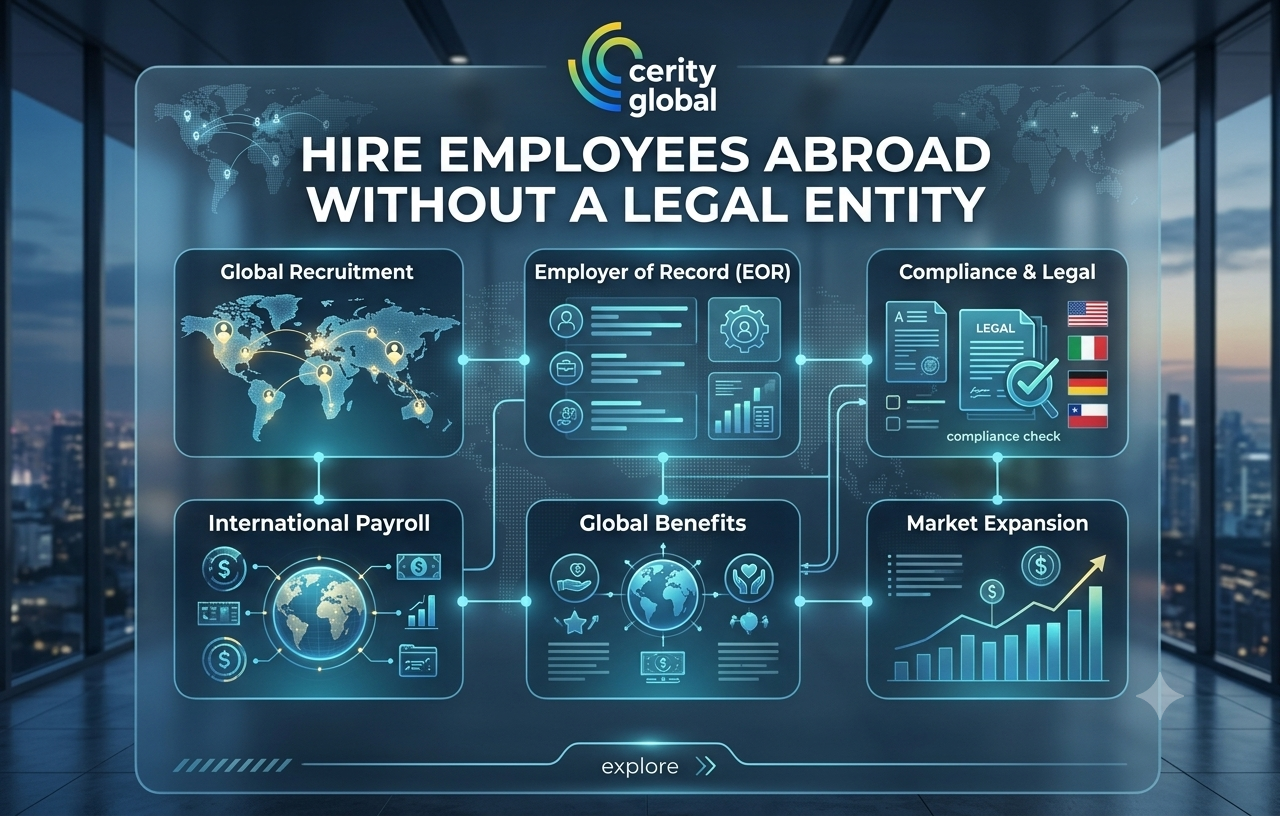
You've come across the right person in Toronto, Warsaw or Pune. The interviews are complete, the offer has been made, and the individual is available to join in three weeks. Next, an issue comes up that could slow things down, as you need to decide who will hire them.
This is where a lot of companies struggling to hire international employees face the challenge. While sourcing talent across borders is simpler than ever, there is far more than just the offer of letter and salary to consider when hiring someone abroad. Before the first working day, local payroll, employment regulations, tax, and statutory benefits must be covered.
In general, without a local entity, companies have three options. They can register a legal entity, hire through an Employer of Record (EOR), or engage a self-employed independent contractor (ICE) if the circumstances are right. Each option comes with different costs, responsibilities, timelines and compliance requirements.
The ruling also should be read in the context of the OECD's 2025 model tax convention update addressing whether cross-border remote working arrangements can lead to a taxable presence for a business.
This detailed guide explores each hiring pathway, the pitfalls, the time it can take to register an entity, and what businesses should consider before opting for hiring a short-term entity over a legal entity.
Can You Hire Abroad Without Establishing a Local Company?
Yes, a foreign business does not always need to establish a subsidiary before hiring its first international employee. Depending on the country, it may be possible to hire through an EOR, register directly as a foreign employer for certain obligations, or engage an independent contractor.
However, not having a local subsidiary does not mean that the company has no compliance obligations in that market.
In many cases, for example, employers must register with the social security institution in the country where the employee works, even without a registered business there. Local tax, payroll, and employment requirements may also apply.
The best solution depends on the company's plans. Is it testing a new market with one employee? Building a permanent regional team? Transferring an existing employee to another country? Or hiring someone who will develop a local business?
These situations may look similar from an HR point of view, but they can have very different legal and tax implications.
Four Ways to Hire Employees Without a Local Subsidiary
1. Hire Through an Employer of Record (EOR)
An EOR legally employs a worker on behalf of a foreign company. It signs the local employment agreement, processes payroll, withholds taxes, and administers statutory benefits, while the client company generally manages day-to-day work.
A US company hiring two software engineers in Poland may use an EOR with a local employing structure instead of immediately establishing a subsidiary.
An EOR may suit a company for testing a market, hiring before its entity is operational, or starting with a small team. Fees are recurring and charged in addition to salary, employer contributions, and benefits. Review who controls employment decisions, intellectual property, termination, and compliance. An EOR may support an initial hire but may not remain suitable as the business grows.
2. Use a Professional Employer Organization (PEO)
A PEO provides HR, payroll, and benefits of support. A traditional PEO involves co-employment, and the client usually needs an existing local employing presence. Confirm whether the provider is the legal employer and who handles payroll taxes and statutory contributions. EOR is generally more relevant when the company has no local entity.
3. Engage Independent Contractors
A contractor may be practical when work is genuinely independent and involves defined deliverables. For example, a US marketing firm may hire an Argentine freelance designer for a three-month project.
Fixed hours, close supervision, exclusivity, and integration into the business may create classification risks. Authorities may consider who controls the work, whether the person can serve other clients, who provides equipment, and how permanent the relationship is. Tests vary by country; calling someone a contractor does not make the relationship independent.
4. Allow an Existing Employee to Work Remotely from Another Country
Allowing an existing employee to work remotely abroad may appear simple, but a change in work location can change the company's responsibilities. A German employee of a US company working from Germany may raise questions about local employment protections, payroll withholding, social security, immigration permissions and corporate tax. Duration, work performed, and the applicable tax treaty can affect the position.
What Are the Risks of Hiring Internationally Without the Right Structure?
The key question is not only how the employee will be paid, but if the arrangement remains compliant after the person starts working.
1. Permanent Establishment (PE) and Corporate Tax Exposure
A permanent establishment (PE) is a taxable business presence a company may create in another country under domestic law and tax treaties. If established, the foreign tax authority may tax profits attributable to it.
An employee working abroad does not automatically create a Permanent Establishment (PE) for the company. The nature of their activities matters. A sales director who regularly develops local business, negotiates commercial terms and plays a key role in securing contracts may create a greater PE risk than an employee who occasionally works abroad for personal convenience.
What changed in the OECD's 2025 update?
On 19 November 2025, the OECD released an updated Model Tax Convention commentary to Article 5. It addresses when an employee's home or another location in a different country may be considered a place of business.
The commentary outlines an indicative working-time test:
- Below 50% of working time in that country over a 12-month period, the location would not generally be considered the company's place of business under this test.
- At 50% or more, the circumstances require further assessment, including whether there is a commercial reason for the employee to be there.
An employee working abroad at 80% of the time and regularly serving local clients may create stronger PE concerns. Allowing an employee to work abroad to retain them or reduce office expenses is not sufficient for commercial reasons under the guidance.
The OECD Model does not automatically become domestic law in every country. India has explicitly stated that it does not agree with the working-time threshold and commercial-reason conditions in paragraphs 44.1 to 44.21 of the Article 5 commentary. The 50% test is not a guarantee; businesses must consider the relevant treaties, domestic law, and employee activities.
Source: OECD – 2025 Model Tax Convention Update:
2. Employee Misclassification
Authorities assess the actual working relationship, not only the job title or contract wording. A person who follows the company's schedule, reports to its managers and performs the same duties as employees may raise classification concerns.
Consequences can include unpaid social security contributions, statutory benefit claims, tax adjustments, penalties, and employment disputes.
On 26 February 2026, the US Department of Labor issued a proposed independent contractor rule. It proposes an economic-reality analysis focusing on control over the work and the worker's opportunity for profit or loss. This is not a worldwide standard.
Source: US Department of Labor – 2026 Proposed Rule:
https://www.dol.gov/agencies/whd/flsa/misclassification
3. Payroll and Social Security Duties
Employing someone abroad can create obligations without a subsidiary, including employer registration, payroll withholding, social security contributions, statutory pension and insurance payments, and employment records.
A US company employing someone permanently in France should not assume its US payroll is enough. French employer registration, payroll and social security requirements may also apply.
Source: European Commission – Paying Social Security Contributions:
4. Local Employment Law and Employee Benefits
The company's headquarters location does not remove local employment requirements. Employees may be entitled to minimum wages, paid leave, working-hour protections, notice periods, severance and statutory insurance. A US company hiring in Germany must consider German requirements, not only its standard US contract.
5. Data Protection and Intellectual Property
Review local employment documentation before the employee joins. Employee records may contain identification, bank, salary, and tax information, so understand data protection and cross-border transfer requirements. Define ownership of work produced by international employees, including software, designs, and research.
Legal Entity vs. EOR vs. Contractor: What Should You Choose?
The choice depends on team size, market activity, available time, and the level of control required.
| Factor | Own Legal Entity | EOR | Independent Contractor |
|---|---|---|---|
01Hiring timeline | Weeks to months, depending on country | Often days to weeks | Often days |
02Best suited for | Long-term teams and local operations | Initial hiring and temporary market entry | Independent, project-based work |
03Employment relationship | Direct local employment | Provider is the legal employer | No employment relationship, if genuinely independent |
04Payroll administration | Managed by the company or its provider | Generally managed by the EOR | Based on service invoices and local requirements |
05Ongoing costs | Entity administration and payroll costs | Recurring provider fees per employee | Contract and service costs |
06Operational control | Greater direct control | Shared responsibilities | Limited by the independent arrangement |
07Long-term scalability | Suitable for growing teams | Depends on cost and provider structure | Limited by the nature of the work |
08Compliance exposure | Managed through the company's local structure | Reduced administrative burden, not eliminated | Classification and local tax risks |
How Much Does It Cost to Register a Foreign Legal Entity?
The incorporation fee is only one part of the total cost.
Initial setup costs may include government registration; document preparation, notarization and certification; a registered office; local director or representative requirements; tax and employer registrations; bank account opening; and sector-specific licenses.
Recurring costs may include accounting and bookkeeping; annual returns and tax filings; payroll and statutory contributions; local professional support; registered office expenses; and continuing compliance.
Requirements vary by jurisdiction and entity type. Foreign-owned subsidiaries may have additional documentation or approval requirements.
What Does the Research Say About Registration Timelines?
The World Bank's Business Ready 2024 report assessed 50 economies. Domestic company incorporation could take between three and 80 days, while the reported range for foreign companies extended to 106 days.
These findings are not a universal timeline. Registering for a company is different from getting it ready to hire tax identification; employer registration, payroll and social security registration, bank account setup and other approvals may still be required.
A wider foreign entity setup can range from two to three months to well over a year, depending on country requirements.
Sources: World Bank – Business Ready 2024:
https://www.worldbank.org/en/businessready/publications-2024
World Bank – Registration Timeline Findings:
EOR or Legal Entity: Which Option Is More Cost-Effective?
An EOR charges a recurring service fee per employee. A legal entity requires incorporation of expenses and ongoing administration, which should be compared over 12 to 24 months.
For an EOR, include service fees, employer contributions, salaries, statutory benefits, insurance and provider or transition charges. For an entity, including incorporation, tax and employer registration, accounting and compliance, payroll, local office costs, banking, salaries and statutory benefits.
Scenario A: Hiring two employees for six months
A US company wants to test the Polish market and has no confirmed plans for further recruitment. An EOR could be a suitable first step without immediately establishing a subsidiary.
Scenario B: Hiring eight employees over two years
A company has developed a customer base and expects to hire eight people, with permanent sales and operations teams. Regular EOR charges can become significant. An entity may offer better cost control and direct employment.
These are illustrative scenarios, not fixed break-even rules. Actual costs depend on provider fees, employer contributions, entity maintenance and expected headcount.
Compare the Cost Before Choosing Your Hiring Model
Is an EOR Still the Right Financial Decision for Your Growing Team?
Understand entity setup expenses, ongoing compliance costs, and recurring EOR fees before deciding which structure makes commercial sense.
Request a Hiring Cost Comparison: https://www.cerityglobal.com/contact
When Should a Company Move from an EOR to Its Own Entity?
An EOR can be a practical first step, but companies should review whether it still makes commercial sense.
1.Your hiring plans are becoming predictable. When recruitment becomes consistent, compare the long-term cost of direct employment.
2. You are developing local commercial relationships. Signing customer agreements, invoicing locally, leasing premises or entering supplier contracts may make a registered presence important.
3. You need greater control over employment arrangements. An entity allows direct employment and local HR processes within local law.
4. You are concerned about tax exposure. Local sales, contract negotiation, employee responsibilities, and remote working may require a closer tax review. An entity provides a structure for local operations, although it does not automatically resolve every PE question.
5. Your long-term plans go beyond hiring. If the company intends to build a permanent market presence, employ local leadership, and generate revenue locally, an entity may be more suitable than relying indefinitely on a third-party model.
Planning Your Entity Setup?
Know What It Takes Before You Start Hiring.
Every country has different incorporation requirements and timelines. Share your target country and expected headcount with Cerity Global to understand the steps involved.
Request a Country-Specific Timeline: https://www.cerityglobal.com/contact
A Practical Checklist Before Hiring Your First International Employee
Before choosing a structure, consider:
- Where will the employee work? The location matters for employment, payroll, and tax.
- What will the employee do? Different roles can create different compliance considerations.
- How long will the arrangement continue? A short assignment and permanent role may require different structures.
- Will the employee negotiate local contracts? Review their authority for potential PE exposure.
- How many people will you hire over 12–24 months? Compare EOR expenses with entity setup and maintenance.
How Cerity Global Supports International Hiring and Entity Setup
Choosing a hiring model is only the first decision. Companies also need a plan for registration, payroll, and operational requirements.
Cerity Global supports businesses with global expansion and employment-related requirements across more than 170 countries. Support can cover:
- Interim hiring support: Explore suitable arrangements while the company's entity is being established.
- Legal Entity Setup: Support with incorporation, documentation, local registrations, and bank account setup.
- Transition to direct employment: Plan the transfer to the local company, including employment documentation and payroll continuity.
- Global HR, Payroll and Benefits: Support with local agreements, payroll and statutory benefits.
- International Accounting, Tax and Compliance: Ongoing accounting, reporting, tax and compliance support.
Final Thoughts: Choose a Hiring Model That Supports Your Next Stage of Growth
Hiring internationally without a local entity is possible, and for some businesses, it is the right place to start. An EOR can support a first hire while the company assesses a market. A contractor arrangement can work for genuinely independent projects. Foreign-employer registration may also be possible in certain jurisdictions.
The first hire should not be the only consideration. A company planning a permanent team needs to consider long-term costs, employee responsibilities, local employment requirements, and potential taxable presence. Choose a structure that fits current needs and leaves room for growth.
Ready to Plan Your International Hiring?
Your first international hire should be part of a wider expansion plan, not a decision made in isolation.
Share your target country, headcount, and hiring timeline with Cerity Global. Its team can help assess hiring models, outline entity setup requirements, and plan the transition to direct employment.
Talk to a Global Expansion Expert: https://www.cerityglobal.com/contact
Disclaimer: This article is for general informational purposes only and does not constitute legal, tax or employment advice. Requirements vary by country and depend on the facts of each arrangement. Businesses should seek appropriate local professional advice before making hiring or entity-set-up decisions.
Similar Stories:
How to Set Up a Legal Entity in a Foreign Country?
How Long Does Legal Entity Dissolution Take? A Timeline Across Major Markets
10 Common Payroll Mistakes Companies Make When Hiring Abroad
Frequently Asked Questions (FAQs)
Yes, depending on the country, it may use an EOR, register as a foreign employer, or engage a genuinely independent contractor.